
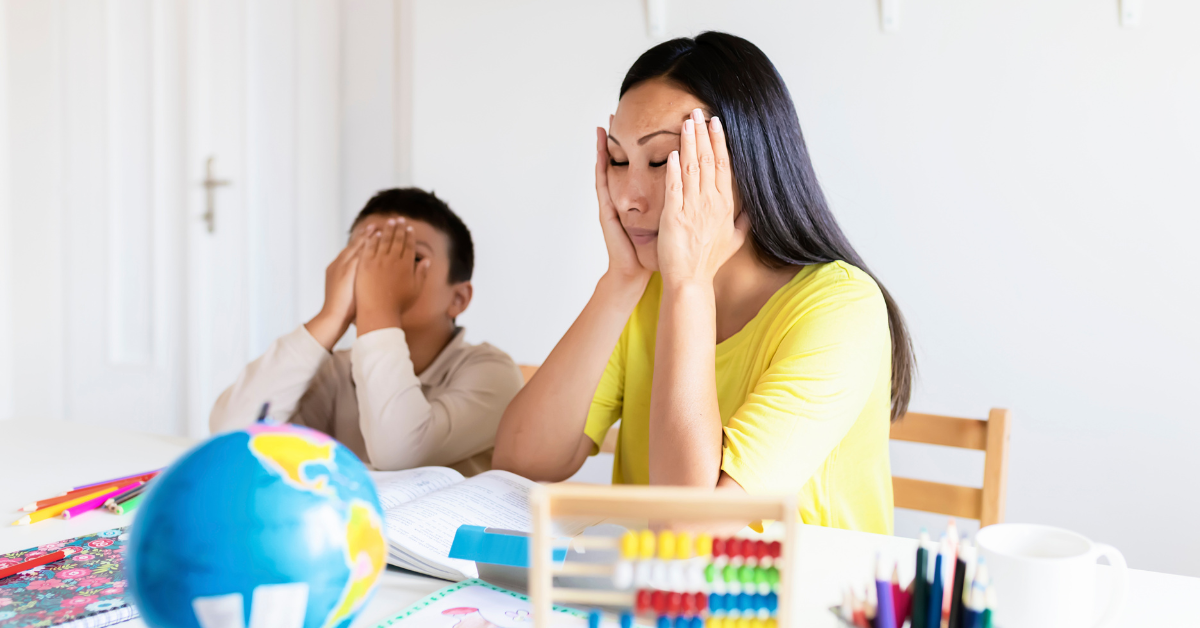
It hasn’t even been a month since the school year started, and already some families are realizing the impact of homeschooling mistakes—with kids begging to go back to school and parents questioning their choice.
If that’s you, take a deep breath. This post is about identifying common homeschooling mistakes that can drain the joy from learning—and how a few small adjustments can bring excitement back into your homeschool.
The Beauty of Homeschooling
Before diving into the challenges, let’s remember why homeschooling can be so powerful.
Homeschooling offers:
- Flexibility to adapt education to your child’s needs, learning style, and pace.
- Freedom to explore topics that excite your child and break free from rigid schedules.
- Individual attention—no dividing time among 24 students.
- Deeper family connection—a chance to spend meaningful time together while children are still young.
Research shows these benefits are real: homeschooled students often score above average on academic achievement tests and report stronger family relationships (Ray, 2023).
But problems arise when learning at home doesn’t feel as engaging as children hoped. Some who were eager to homeschool may suddenly long to return to school.
This isn’t a sign of failure—it’s a signal that some adjustments are needed. Small tweaks can make a huge difference.
Why Kids Miss the Classroom
Even if they don’t love everything about school, children often miss:
- Social interaction – collaborating, sharing ideas, solving problems with peers (even playground disagreements help social growth).
- Movement and transitions – walking between classes, changing activities, and having natural breaks.
- Variety in teaching strategies – in school, teachers mix visual, auditory, and hands-on approaches to reach different learners.
Studies on homeschoolers confirm that while most develop social skills equal to or better than their peers, this only happens when parents intentionally create opportunities for interaction through sports, co-ops, volunteering, or community activities (Medlin, 2013; Parents Magazine, 2022).
If homeschool feels like sitting at the table all day with worksheets or screens, it’s no wonder kids get restless.
Common Homeschooling Mistakes
1. Relying Too Much on Worksheets
Many parents begin with stacks of workbooks and make them the main teaching tool. While worksheets can reinforce concepts, they can’t replace movement, exploration, or hands-on learning. Over-reliance on them often leads to disengagement (Homeschool Academy, 2022).
2. Skipping Social Opportunities
At school, kids constantly interact with peers. At home, they may go days without talking to other children their age, which can leave them feeling isolated. Research shows homeschooled children who lack peer contact may experience more frustration with learning (Medlin, 2013).
3. Sticking to Rigid, Pre-Packaged Curricula
Even schools don’t use just one resource. Teachers blend textbooks, projects, and experiments. A rigid curriculum that doesn’t fit your child’s strengths or personality can quickly become a source of struggle (Verywell Family, 2021).
4. Overemphasis on Completion Instead of Understanding
It’s tempting to check boxes: worksheet done, lesson complete. But if the focus is only on “getting through” material, kids miss the chance to think deeply, ask questions, and explore.
5. Lack of Real-World Connections
Math, science, and literacy can feel abstract without practical application. Research shows that when children engage in real-world, meaningful tasks, they develop stronger social-emotional and cognitive skills (Zhao et al., 2023).
6. Relying Too Heavily on Screens or Apps
Educational apps can be great tools, but when they replace teaching and interaction, children can feel disconnected and unmotivated.
Solutions: Small Tweaks, Big Difference
The good news: homeschooling doesn’t require perfection. With thoughtful changes, you can bring the best of both worlds—school and home—together.
- Mix teaching styles: Combine visual, auditory, and hands-on activities. Don’t lean only on worksheets or reading.
- Incorporate movement: Add projects, games, and science experiments. Even walking while reviewing flashcards helps.
- Encourage peer interaction: Join co-ops, online groups, or set up playdates and collaborative projects.
- Choose resources that fit your child: Match curriculum to their strengths, needs, and personality rather than forcing one program.
- Scaffold learning: Break tasks into manageable steps, guide your child when needed, then allow independent exploration. This echoes psychologist Lev Vygotsky’s Zone of Proximal Development, which shows children learn best with guided support that gradually fades (Verywell Mind, 2022).
- Make real-world connections: Cook to practice fractions, garden for science, write letters for literacy. Show how learning lives outside the workbook.
Final Thoughts
Homeschooling is a journey. With a few adjustments, you can turn homeschooling mistakes into learning opportunities for both you and your child.
It’s okay to make mistakes—it actually helps when your child sees you adjust, ask questions, and try again.
So if your child is asking to go back to school, don’t panic. See it as an invitation to make homeschooling more engaging, flexible, and connected. With a few intentional shifts, you can help your child rediscover the excitement of learning at home.
Let’s Stay Connected
If you’d like extra support, I work 1:1 with parents through my Parent Coaching Services and also offer workshops on creating thriving homeschool experiences. I’d love to help you make homeschooling not just workable—but joyful and engaging for your family.
References
- Homeschool Academy. (2022). Top Ten Homeschooling Mistakes and How to Avoid Them. Retrieved from homeschoolacademy.com
- Medlin, R. G. (2013). Homeschooling and the Question of Socialization Revisited. Peabody Journal of Education, 88(3), 284–297.
- Parents Magazine. (2022). Homeschool Socialization: How to Keep Kids Connected. Retrieved from parents.com
- Ray, B. (2023). Research Facts on Homeschooling. National Home Education Research Institute. Retrieved from nheri.org
- Verywell Family. (2021). The Pros and Cons of Homeschooling. Retrieved from verywellfamily.com
- Verywell Mind. (2022). What Is the Zone of Proximal Development? Retrieved from verywellmind.com
- Zhao, Y., et al. (2023). Home Learning Environment and Children’s Social-Emotional Development in Early Childhood. Frontiers in Psychology, 14, 1081116.